It’s not just what you eat, when you eat may matter even more⏰
Dec 27, 2025
Please note:
This was originally sent to my newsletter.
Join here to get future posts directly in your inbox.
Hi Friends🙋♂️,
First of all, Merry Christmas 🎄
I hope these days find you surrounded by people who matter to you rested, present, and at peace.
And thank you.🙏
Your messages, encouragement, and thoughtful feedback truly mean a lot to me. Knowing that these newsletters bring real value is what keeps me writing.✍️
Over the last few weeks, we talked about what to eat.🥣
Today, I’d like to shift the focus to something just as powerful, but far less discussed:
When should we eat?
Welcome to chronobiology.⏰
Chrono...what?
Chronobiology is the science of biological timing.
Almost every cell in your body has its own internal clock, running on roughly a 24-hour rhythm.
These clocks regulate:
metabolism💧
hormone release🧠
digestion🥗
sleep😴
energy levels⚡️
Here’s something remarkable:
If you placed me in a completely dark room for more than a day – no sunlight at all – my cells would still maintain their daily rhythm.😱
That’s how deeply programmed this system is.
The Sun acts as the main conductor, gently synchronizing all these clocks.
That’s why you tend to feel hungry, sleepy, or even need the bathroom at similar times each day.
There is a right time for:
physical activity🏃
deep sleep💤
recovery🌱
and yes… eating😋
This isn’t theoretical.
In oncology for example, the same dose of chemotherapy given at the right time of day can be:
up to twice as effective, and five times less toxic.❗️
Timing alone changes outcomes. Not only in oncology, but in our diet as well.
So let’s bring this idea into everyday life.
Is breakfast really the most important meal?
You’ve probably heard this before, but is it actually true?
A fascinating experiment from the 1990s gives us a clue.
Researchers infused people with the same amount of glucose continuously over 24 hours and measured blood sugar responses.
(PMID: 1965834)
What they found was striking:
👉 The exact same sugar caused much higher blood-glucose spikes later in the day.❗️
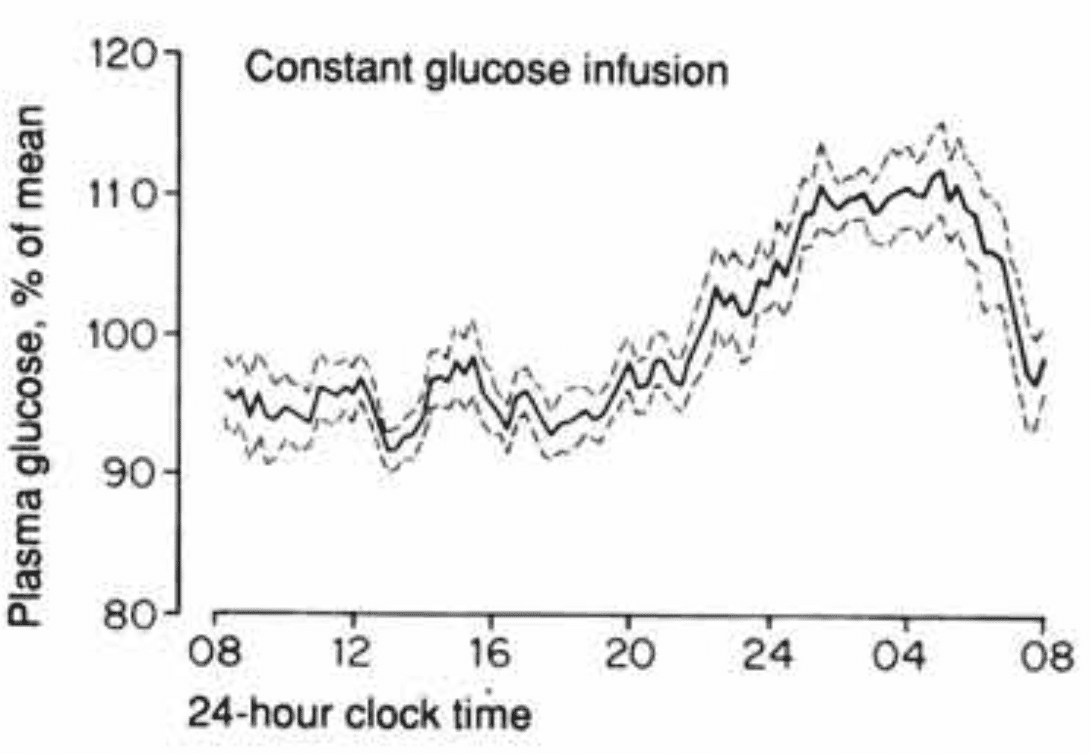 How our body reacts to constant glucose infusion. PMID: 1965834 |
In other words, our ability to handle sugar deteriorates as the day goes on.
Our bodies simply don’t expect large meals when it’s dark outside.
The same dinner eaten at night stresses metabolism far more than the same meal eaten earlier in the day.⏰
(PMID: 23705984)
And you may feel the effects the next day:
lower energy🪫
worse blood-sugar control🩸
sluggishness🥱
Calories earlier = better results
There’s an old saying:
Eat breakfast like a king, lunch like a citizen, and dinner like a pauper.
Surprisingly, modern science supports this wisdom.
In a controlled study, two groups ate the same food and the same calories.
The only difference was timing.
(PMID: 23512957).
One group consumed most calories in the evening. The other front-loaded calories earlier in the day.
👉 The front-loading group lost significantly more weight.
In a different study, even without weight loss or calorie restriction, eating earlier improved:
insulin sensitivity (our ability to handle sugar)🩸
blood pressure🩺
mood😄
sleep🛌
(PMID: 29754952)
Same food. Same calories.
Different timing → different biology.
Why food timing works
Food timing is one of the strongest biological signals called “zeitgebers” for our peripheral clocks, especially in the:
liver
pancreas
gut
adipose tissue
Time-restricted eating (TRE) helps re-synchronize these clocks–even without calorie reduction.
What human studies show us so far:
↓ fasting and nocturnal glucose
↓ blood pressure
↑ insulin sensitivity (especially in prediabetes)
↓ evening hunger
↑ sleep satisfaction
Important nuance:
Benefits are strongest when eating occurs earlier in the day.
Late eating windows – and very late one-meal-per-day patterns – can actually worsen glucose tolerance.
Why?
Because melatonin rises at night and suppresses insulin secretion, making late eating metabolically unfavorable.
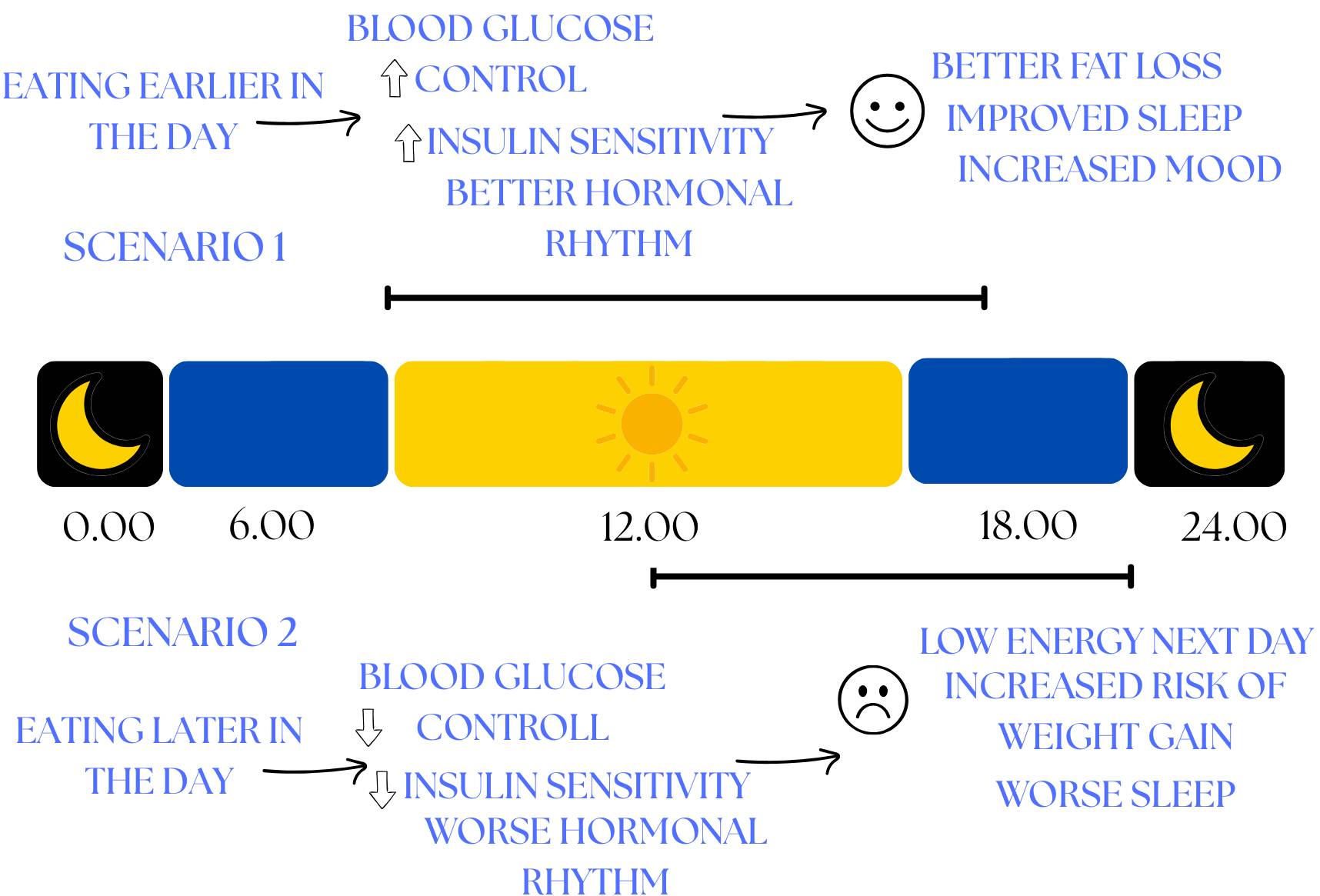 Frontloading vs. backloading our calories throughout the day. |
So what should you take away from this?
If your goal is:
steadier energy🔋
better blood-sugar control🩸
easier weight regulation𐄷
One simple strategy can help enormously:
Don’t skip breakfast. Eat more earlier in the day. Go lighter in the evening.
If you want to skip any meal, you should skip dinner, rather than breakfast.
(PMIDs: 26220945, 24847666, 34550357)
This is a small change – but it creates a large physiological ripple effect.
Personally, I:
🍽️eat within an 8–10-hour window
⏳start eating at least 1 hour after waking
🛑finish eating 2–3 hours before sleep
I recommend you to do some similar.
One last thing, especially for the holidays
Please do me one favor.
Don’t stress about calories.
Don’t worry about missing workouts.
Don’t fear “losing progress.”
Time spent with loved ones does not erase your health gains.🌱
Health is not built in a single week. And it’s certainly not destroyed in one.
Enjoy these days!
Thank you for joining!
See you in 2026,
Warmly,
Bazil