Simple tip to eat healthier🌱
Nov 14, 2025
Please note:
This was originally sent to my newsletter.
Join here to get future posts directly in your inbox.
Hi Friends,
First of all, thank you so much for all your support! I haven't even sent my first letter, and so many of you have already sent me positive feedback and reinforcement. I am genuinely grateful for these, and they mean a lot to me!
Today, I want to give you a concrete anchor to come back anytime you need to reset your diet or start anew to get back on the healthy path.
Let's dive in!
In the last couple of weeks, several people asked me during casual conversations when the concept of "healthy eating" came up. How can I start to eat healthier? Where should I begin?" I totally understand them, because nowadays there is so much noise in this field, and it's very challenging to find a relevant starting point. Today, I hope I can help you with that.
Every time we eat, we decide what we put in our bodies, which will have its own effect on us. We have the opportunity to choose something healthy and nourishing (like an amazing bean burrito), but also to pick a milkshake and a burger (which permanently feels good but isn't the best for our health).
In the majority of cases, when lifestyle medicine physicians begin treating their patients, they start with the nutritional aspect of the six pillars. (We will talk about the six pillars of LM later.) The reason behind this is that almost everybody eats at least three times a day, so it's not surprising that this is the most clear place where we can make a change.
Before I'd tell you anything, I would like to show you a diagram:
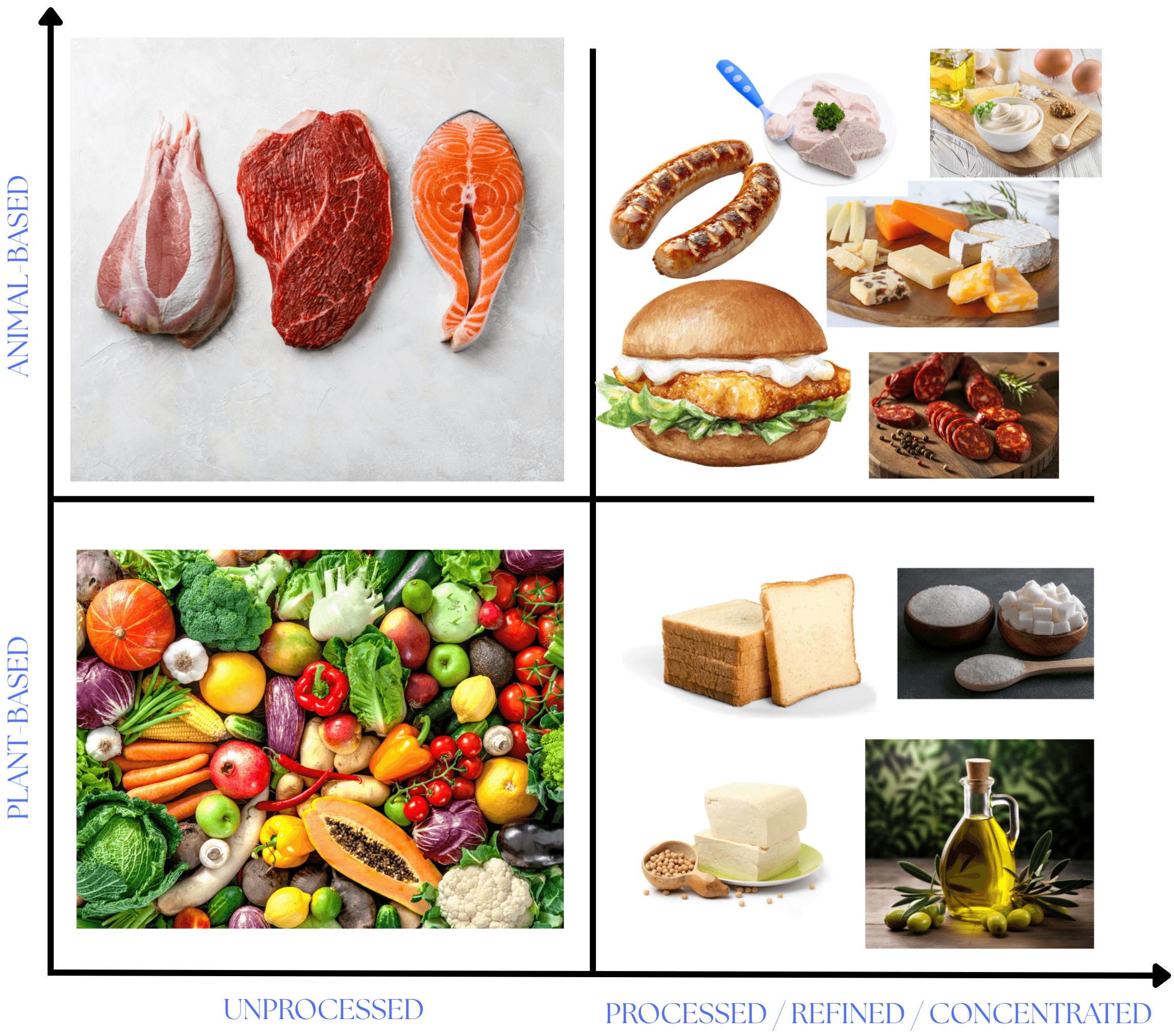
What can we see here?
This diagram is about our diet.
There are four big categories altogether from which we can choose. On the Y axis, you can see that we consume animal and plant-based food, and on the other axis, there are the unprocessed and processed foods.
Let's take a quick look at what they mean exactly!
Animal-based processed / refined / concentrated food
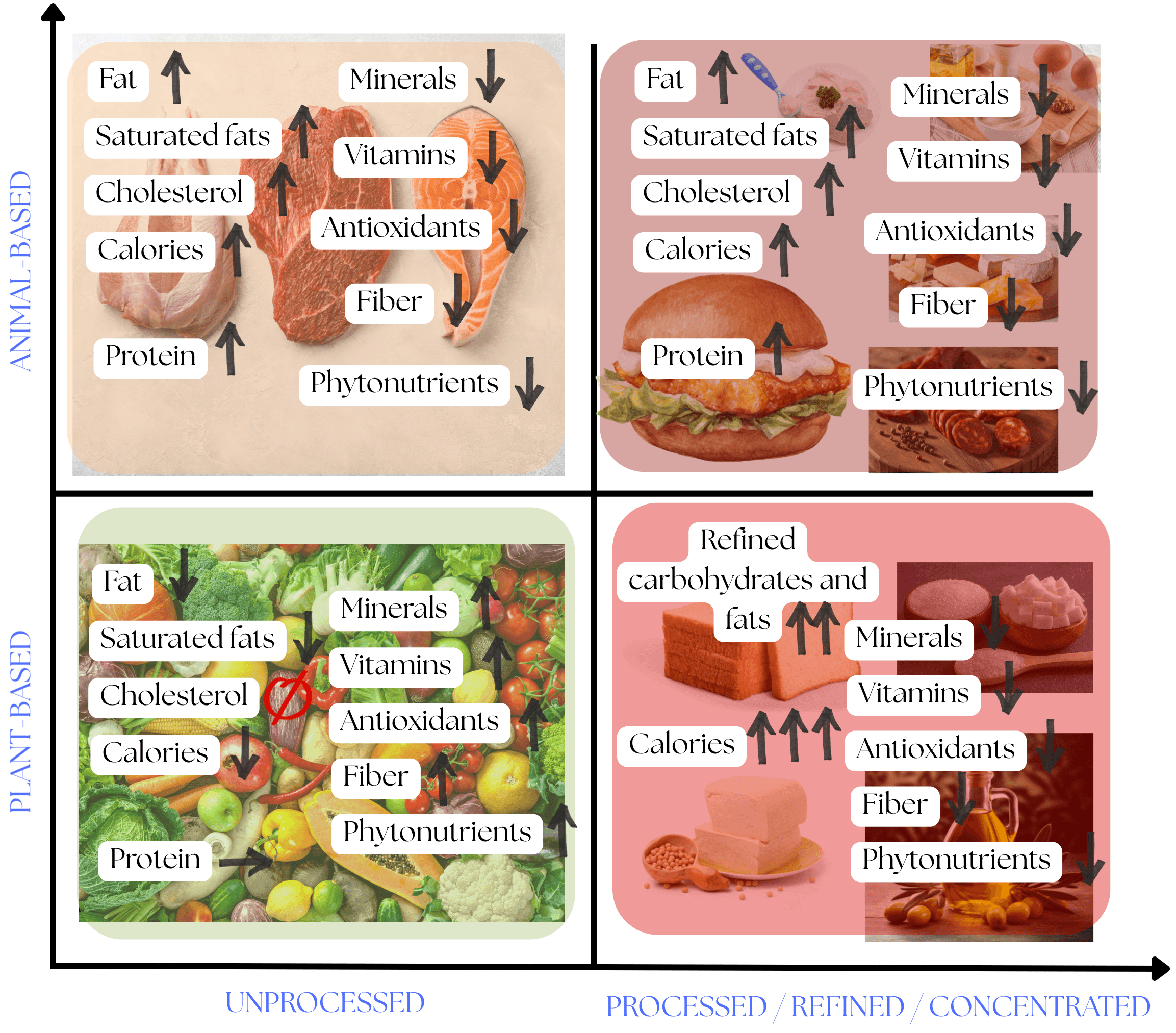
Suppose you eat animal-based processed foods (like sausage, hot dogs, cheese, bacon). In that case, they usually contain a high amount of excess chemicals and an enormous amount of salt and fat (usually cholesterol, saturated fats, and trans-fats, which we know build up in your arteries and can cause severe health issues). They also contain a high amount of calories and proteins. (We will talk about proteins in a different newsletter as well) If these weren't enough, the WHO declared these as type 2 carcinogens, which means they elevate the risk of developing cancer. Unfortunately, they contain a small amount of vitamins but lack micronutrients (such as fiber or phytonutrients) because they underwent a "condensing" process that eliminated all of these nutrients. Furthermore, since they are very calorie-dense foods, you need to be actually aware of how much you eat from them.
Plant-based processed / refined / concentrated food
Suppose you eat plant-based processed foods (For example, vegan meat slices, olive oil, and white bread, etc). Most of the time, they are not healthy either, as they often contain excessive amounts of refined fat and carbohydrates (such as added sugars) and chemicals, while eliminating many micronutrients (for example, fiber). There are some exceptions, though, such as tofu or tempeh, which are considered "processed" foods, but we still consider them healthy due to the health benefits of tofu.
FYI: Even if something is labeled as "vegan" in a store, it does not mean it is healthy. Most of the time, they also contain a lot of calories but fewer micronutrients (such as fiber, vitamins, antioxidants, and phytonutrients).
Animal-based unprocessed food
If you eat unprocessed animal products, they are better because they have not gone through an industrial process, but they still contain lots of fat, trans-fats, and cholesterol, which can build up in our arteries as well. They also include a high amount of calories and proteins. Unfortunately, they do not contain fiber, vitamins, or antioxidants.
Plant-based unprocessed food
Last but not least: the unprocessed plant-based food, which contains high amounts of micronutrients (vitamins, fiber, phytonutrients, antioxidants, etc), and if you eat enough of them, they contain lots of and enough macronutrients (for example, protein) as well. They include a lower amount of fats, trans-fats, and do not contain any cholesterol. They are the most beneficial for us, since they are high in macro- and micronutrients as well. When you eat a lot of them, you nourish your microbiome, lower your cholesterol and triglycerides, and decrease your inflammation in your body. Thanks to these effects, you will have more energy, sleep better, feel lighter and regenerate more efficiently after your workouts.
See the detailed diagram here:
So here is my most important advice if you want to start eating healthier:
Focus on what you should eat, not on what you should avoid, meaning that our diet is a spectrum, not a black-and-white issue.
To narrow this down, I'd expand it with one more thing.
Focus on increasing your fiber intake by consuming more whole, plant-based foods.
My girlfriend can attest that I can talk for hours about our gut and fibers, their role in our longevity, but I'll save that for later.
Focusing on what you should eat will open up many opportunities that you may not have even considered, because until then, you only saw the restrictions and the "can nots".
So, next time you go to the grocery store, focus on what you should eat: unprocessed, whole, plant-based foods! Grab some cans of legumes (like beans or chickpeas), buy some lettuce, or opt for frozen fruit!
That's all for today, guys. Thank you for reading!
I hope you enjoyed. Don't forget to share this with one of your friends who'd find this useful!
I'd love to hear your feedback and also what the following newsletter should be about!
Feel free to contact me via email or send a message.
Thank you for joining!
See you in the next one,
Cheers,
Bazil